
Money is a tricky subject at the best of times. They tell you it doesn’t bring happiness, and yet you cannot have a good quality of life without it. This abstract concept of different values being placed on printed pieces of paper, and nowadays more often than not on digital numbers, is not something a lot of us want to think about. Yet, it is what our society revolves around. ‘Money makes the world go round’ after all.
Money functions because we, collectively, decided so. It holds value because humans decided so. Admittedly, it is the biggest social construct we came up with, perhaps bigger than social classes, time or even religion, because whether you want to or not, you have to participate in it. As the greatest medium of exchange, money allows us to procure goods and services that we want, but also that we need in order to survive. From food, shelter and heat, to extravagant items, luxurious holidays and cars, or designer purses, it allows for a lot, and it’s been around for a while.
Prior to the introduction of tangible money (coins and paper), exchange or barter between goods and services was also tangible, using valuable items such as cattle or grain. The first coin, made out of gold/silver alloy and stamped with royal symbols, was created in the Kingdom of Lydia (modern-day Turkey) in the 7th century BCE. It was very quickly adapted as a far more efficient solution for exchange. Paper money followed not too long after, in the 8th-9th century BC, again due to its efficiency. It allowed for bigger exchanges of higher value after first appearing in China during the Tang Dynasty. As years went by, the system has developed significantly, with financial systems coming into play. With the introduction of the digital age in the late 20th and early 21st century, the currency also shifted. We rely far less on physical money, instead focusing on it in the form of electronic records, whether in banks or bitcoins, and more.
APR, diversification, shares, interests, compounding – all of these are financial concepts talked about daily by many. And yet, I barely have an idea what any of them mean.
‘Money is everywhere, it affects all of us and confuses most of us.’
It is not a topic well-taught, if at all, in a general sense, whether in school or college. No one explained to me how to take care of my personal finances well. It was all trial and error, asking others, and reading websites, piecing the information together. And yet I still don’t know how to use my money effectively. All I know is that I need it for the life that I want.
‘The highest form of wealth is the ability to wake up every morning and say “I can do whatever I want today.”‘
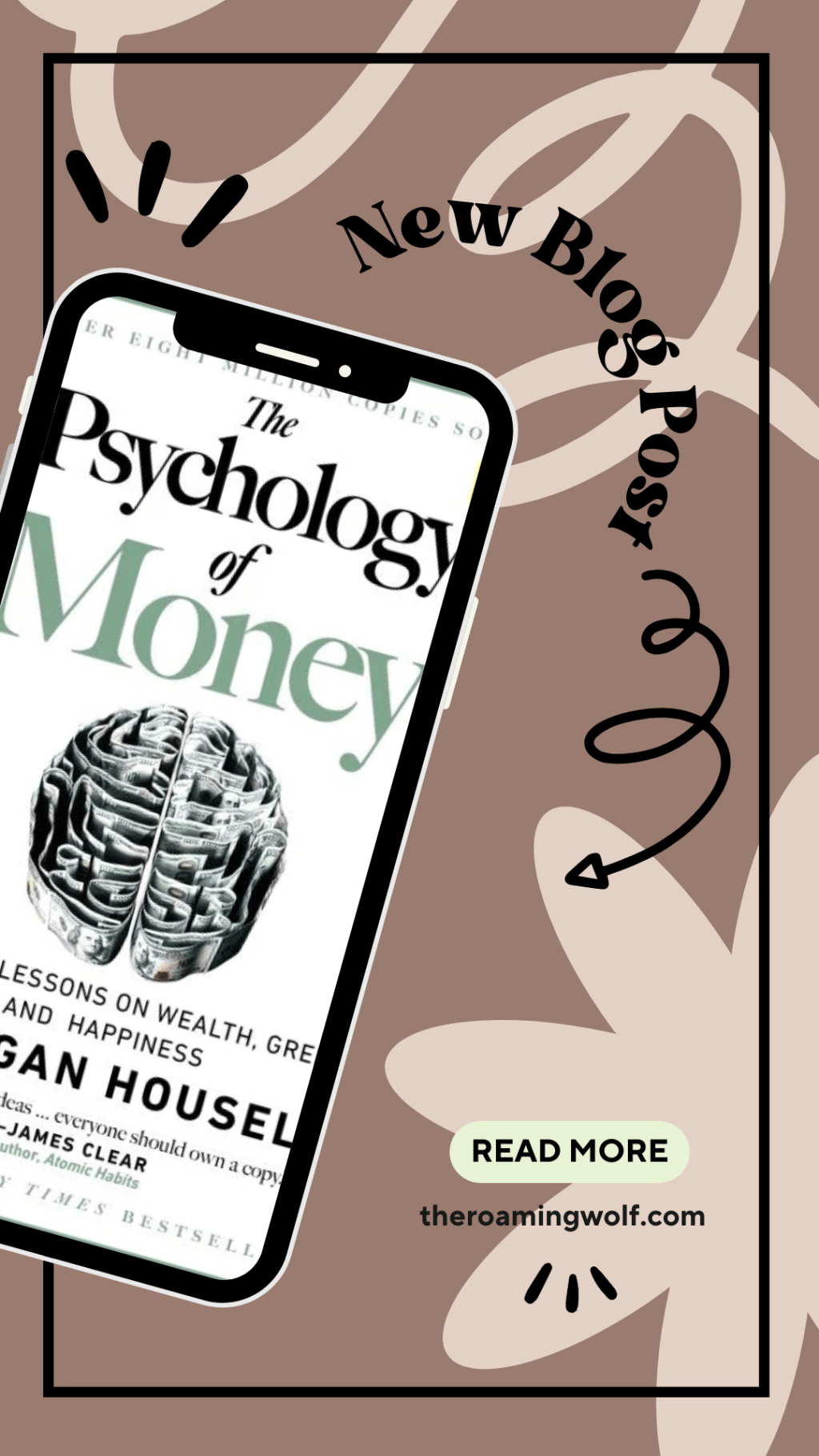
I picked up Morgan Housel’s book titled ‘The Psychology of Money’ in hopes of helping me find a better way to think about my finances and how to make sense of them. The author clearly states that he believes we should think about money more with soft skills of psychology (with emotions and nuance), rather than hard, cold way (with rules and laws).
‘It’s a soft skill, where how you behave is more important than what you know.’
The book contains twenty chapters filled with short stories to help its readers understand that there is more to money than just its technical side. They all form a coherent story but can be read independently, ensuring you can always come back to the ones that caught your interest. It tackles some of the biggest money topics, such as saving, investing and more.
I think total beginners, such as myself, will benefit the most from this book. It gives a good introduction to much deeper and bigger topics that you can research further. It lays the fundamental concepts in an easy and digestible manner. They’re kept short and to the point, which is always a benefit.
‘There is never a moment when you’re so right that you can bet every chip in front of you. The world isn’t that kind to anyone – not consistently, anyway. You have to give yourself room for error. You have to plan on your plan not going according to the plan.’
I really enjoyed this read. It gave me a lot of points to consider, which I don’t think I would otherwise ponder on. It gives general advice I needed to hear, but keep in mind that not all of it might be applicable to you. It does not give you an action to carry out or an exact answer on what to invest in, etc. I hope you’re not expecting that from it, because that wouldn’t be fair. No random author is going to take that responsibility in a book without knowing a thing about you or your finances. If you’re looking for such specifics, you’ll need to find a personal financial advisor. ‘The Psychology of Money’ is a good introduction to the topics, nevertheless. Worst-case scenario, it is not a long book, so you won’t have to suffer through it for long if you don’t like it!
One more thing I will mention as well, for all Non-Americans out here, this book is more tailored towards the American public. It didn’t stop me from enjoying it, but there was no hiding the fact! This book didn’t give out a golden answer on what to do exactly, but it did spark my mind to think about the topic a little bit deeply. Is there any sage financial advice that keeps you going? If so, let me know down in the comment section below, would love to hear it!


Leave a Reply